GraphQL is not new in the FileNet world. It has been around since the 5.5.x line, long before every discussion started getting folded into CP4BA.
That is exactly why Content Cortex is worth looking at from a different angle.
The story here is not that IBM added GraphQL to the stack. The story is that the schema is front and center, and that changes how you approach content access.
After looking through the Content Cortex development material alongside IBM’s published Content Services GraphQL schema and JavaScript samples, what stands out is not the transport or the syntax. It is the fact that the schema becomes the contract you build against.
That is the part that matters.
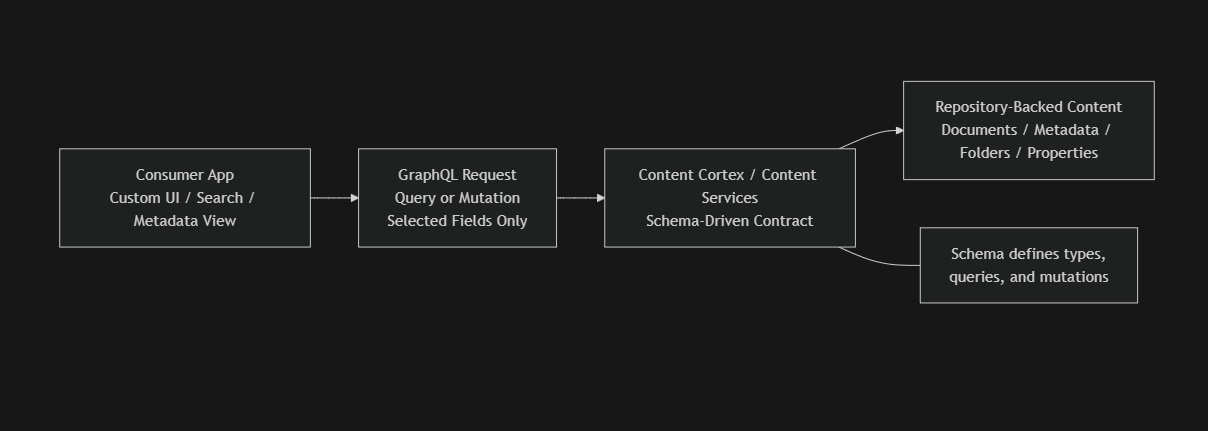
The problem was never access
FileNet never had a shortage of APIs. There was always a way to reach content, object metadata, classes, folders, and property values.
What usually caused friction was the shape of consumption.
Too much payload. Too much response shaping in the client. Too much coupling between backend structure and what the application actually needed. Too much code spent pulling apart responses and stitching together something usable.
That is where a schema-driven model starts to pay off.
The schema tells the real story
The most useful artifact in all of this is not the marketing language and not even the overview page. It is the schema itself.
IBM published a Content Services GraphQL schema sample, and it is the fastest way to understand how the model is exposed. Looking at the graphQL.js file tells you more than any generic explanation ever will.
You can see the actual types, the query structure, the object model, and how repository-backed content is represented.
That matters because in a GraphQL-based surface, the schema is not background detail. It is the API.
Once you look at it that way, the conversation becomes much more concrete. You stop talking about GraphQL as an abstract capability and start looking at whether the exposed model is actually useful.
The JavaScript sample makes the picture clearer
The other useful piece IBM published is the JavaScript sample.
This matters because GraphQL is easy to describe in theory and much more revealing in client code. The app.js sample shows how the request is assembled and how the response is consumed from application code.
That is where the value becomes practical.
If the schema is well designed, the client stays focused. You build a request around the fields you need, send it, and work with a response that is already much closer to the shape the consumer wants.
That is a better development experience than hauling back a large response and carving it down after the fact.
Why Content Cortex is interesting
What makes Content Cortex worth paying attention to is that it continues this schema-driven way of exposing content-related capabilities.
That is the useful part.
The consumer gets to work against a typed contract. The request is shaped around the consumer need, not around a fixed backend payload. The result is a cleaner path from repository-backed data to application-facing structure.
That is a much better fit for content-heavy applications, especially where the consumer needs a selective projection instead of a broad response.
This is the difference that matters in practice. Not whether GraphQL exists, but whether the exposed schema gives you a cleaner model to build against.
A better developer surface
In the old pattern, the work often started after the API call. You retrieved a lot, filtered a lot, and transformed a lot.
With a schema-driven surface, more of that control moves into the request itself.
That changes the developer experience in a useful way.
The schema defines the available types. The query defines the projection. The client asks for what it needs and gets back a response shaped around that choice.
That is why the schema matters more than the fact that GraphQL is being used.
Real value for content-centric applications
This model is especially useful when the application is content-centric and selective by nature.
That includes cases where the consumer needs:
specific metadata fields
repository object information without excess payload
focused views over content structures
a cleaner contract between UI and backend data
For this kind of work, a well-exposed schema is easier to reason about than broad endpoint responses that have to be trimmed and reworked in the application layer.
That is the practical advantage.
Final thought
Content Cortex is not interesting because it uses GraphQL. GraphQL has been in the FileNet stack for years.
What makes it worth paying attention to is the way the schema becomes the primary developer surface. That shifts the conversation from generic API access to a typed, consumer-shaped contract for working with content services.
And in this space, that is the part that actually improves the development experience.
References
Content Cortex Development Overview
https://www.ibm.com/docs/en/content-cortex/26.0.1?topic=development-overview
Example Queries and Mutations
https://www.ibm.com/docs/en/content-cortex/26.0.1?topic=development-example-queries-mutations
Content Services GraphQL schema sample
Content Services GraphQL JavaScript sample
#IBM #CP4BA #FileNet #ContentManagement #GraphQL #ECM #ContentCortex
About the author
- IBM ECM specialist and full stack developer sharing real-world lessons on CP4BA, FileNet, BAW, Java, and modern application architecture.
Comments
Join the discussionNo comments yet. Be the first to comment.